ResearchDevelopmentImplementationBarriersImpact

Persona Strategy

Developing Targeted User Personas to Drive Adoption and Engagement

Delivering a more tailored and seamless QuickBooks experience that aligns with specific needs, behaviours, and pain points.

Challenges

When small business owners seek accounting software, they face a variety of challenges in selecting, implementing, and fully utilising a digital solution. At Intuit, we recognised that different types of business owners have distinct needs, concerns, and adoption patterns when it comes to financial management tools.

How might we tailor the experiences we deliver to specific customer personas?

Objective

Our objective was to develop detailed, actionable user personas to inform product development, marketing, and customer support strategies. By understanding user behaviors, pain points, and motivations, we aimed to:

RESEARCH

To create effective and actionable personas, our research was guided by several key objectives:

1. Understand User Needs and Pain Points

2. Segment Users Based on Behaviour, Not Just Demographics

3. Map the Customer Journey from Discovery to Retention

4. Assess Competitive Perceptions and Barriers to Adoption

5. Validate Messaging and Product Positioning

Research Process

To develop robust personas, we undertook a multi-stage research process, which included:

Why Personas Instead of Generic Market Research?

Rather than relying solely on traditional market research methods or broad segmentation strategies, we chose to develop personas because they provide a more holistic and human-centered understanding of our users.

Beyond Demographics

Market segmentation often relies on age, industry, or business size, but these factors don’t always determine behaviour. Personas focus on the mindset, motivations, and workflows of users, helping us design more intuitive experiences.

More Actionable Insights

Generic market research can yield broad trends, but it often lacks the depth to inform specific product features, marketing messages, and support strategies. Personas allow us to build realistic scenarios for product interactions.

Avoiding a "Unit of One" Approach

While focusing on individual user stories can be useful, it doesn't scale for business-wide decisions. Personas balance specificity and generalisability, representing real customer archetypes without limiting us to anecdotal data.

Cross-Functional Alignment

Personas provided a common language for product teams, marketing, and customer support to align on the most critical user needs, ensuring consistency across all user touchpoints.

"We didn’t need another doc full of customer stats—we needed a way to step into our customers’ shoes. The moment we started thinking about Anasta and Chris as real people with real problems, we stopped asking ‘How do we sell this?’ and started asking ‘How do we help them succeed?’ That shift changed everything"
- Scott Downing
Director of International Customer Success, Intuit

DEVELOPMENT

Persona Development

Alison - The Independant "Up and Comer"

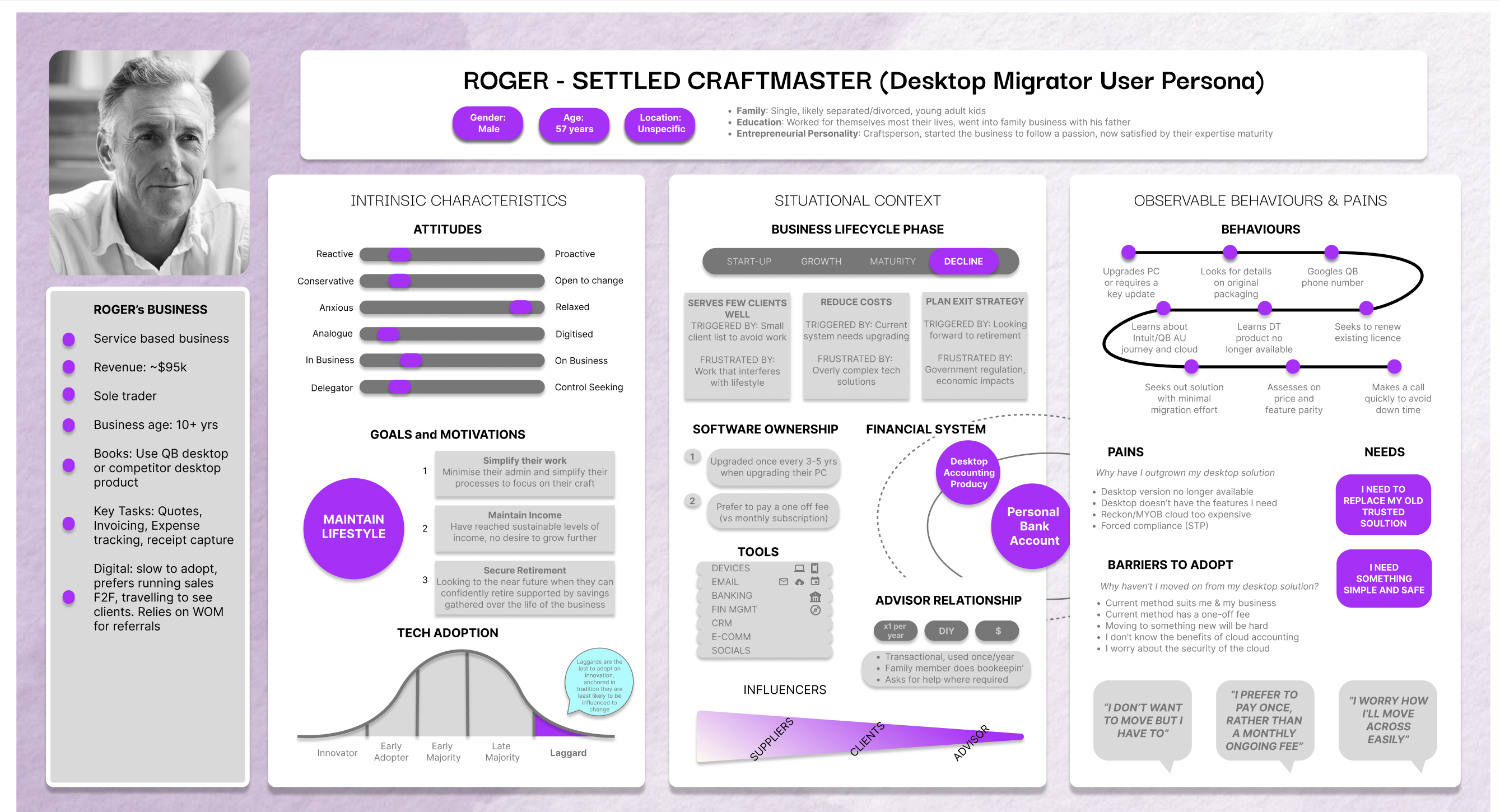
Roger – The Settled Craftmaster

View Final DesignView Final Design

IMPLEMENTATION AND CULTURAL SHIFT

The implementation of these personas led to a profound cultural shift across the organisation. Rather than being a one-time research project, the personas became a foundational framework that influenced how teams across Intuit approached their work.

Mindset Shift Across Teams
Employees across marketing, product, and customer support started thinking beyond features and numbers, asking themselves, “How does this impact an Anasta or a Chris?” The personas became an anchor for decision-making across the customer journey.

Refined Success Metrics:
Leadership began tracking how many new 'Alison' and 'Roger' customers were onboarded instead of just total new sign-ups. The focus shifted from raw acquisition to ensuring that new users were the right fit and were receiving an experience tailored to their needs.

New Persona-Based Initiatives: 
The personas inspired multiple cross-functional projects aimed at improving the Alison and Roger experience:

Elevated Strategic Conversations:
Leadership conversations evolved from general business growth strategies to persona-driven strategies, ensuring alignment between long-term company goals and real user needs.

BARRIERS AND PERSONAL REFLECTIONS

The journey to implementing these personas wasn’t without its challenges. One of the biggest hurdles was convincing marketing and sales teams that this approach was worth the investment.

Insights from the course

Skepticism from Leadership: Initially, there was resistance—some saw personas as “just another marketing exercise” rather than a data-driven strategic shift.
Proving the Business Value: It took multiple presentations, real-world examples, and small-scale tests to demonstrate that personas could drive measurable improvements in conversion and retention.
Shifting the Sales Mentality: Sales teams were accustomed to thinking in terms of total sign-ups, rather than acquiring the right customers who would succeed with QuickBooks. It took months of engagement to shift the conversation towards long-term customer success over short-term volume.
Changing the Marketing Playbook: Marketing campaigns had to be adjusted to reflect the nuances of Anasta’s and Chris’ decision-making processes, rather than relying on broad-stroke messaging.

Looking back, these obstacles were worth overcoming. Once teams started seeing results, they became champions of the persona approach, further embedding it into our culture. Today, the impact is clear—not just in how we design products and marketing strategies, but in how we talk about and understand our customers at every level of the business.

IMPACT

By developing deeply researched, behaviour-based user personas, we enabled Intuit to create more relevant, empathetic, and effective solutions for small business owners.

15%

6 pts

20%

Higher Trial-to-Paid Conversion Rates for Users who received persona-based onboarding compared to those in the general onboarding funnel.

Improvement in NPS for customers from persona based messaging, particularly those transitioning from manual methods.

Reduced Churn Among Desktop Users by addressing migration concerns upfront